# Implement Fees on Pyth Core Across Networks #2
**URL:** https://forum.pyth.network/t/implement-fees-on-pyth-core-across-networks-2/2114
**Category:** Ideas Bank
**Created:** [April 25, 2025, 12:59pm UTC](https://forum.pyth.network/t/implement-fees-on-pyth-core-across-networks-2/2114 "2025-04-25T12:59:44Z")
**Posts on this page:** 20
**Page:** 1
### Author:  [@KemarTiti](https://forum.pyth.network/u/KemarTiti)
#### Post date: [April 25, 2025, 12:59pm UTC](https://forum.pyth.network/t/implement-fees-on-pyth-core-across-networks-2/2114/1 "2025-04-25T12:59:44Z")
## Background
In February 2025, the Pyth community and DAO approved an [increase in oracle fees](https://forum.pyth.network/t/passed-op-pip-50-implement-pyth-update-fees-on-8-blockchains/1943/2) on a subset of chains where Pyth is deployed.
Shortly after, the community proposed a broader pricing model: [charging roughly $0.10 per price feed update](https://forum.pyth.network/t/switching-oracle-fees-13m-opportunity-per-year-and-reinvesting-in-growth/2052) across most supported chains. While this sparked discussion, feedback from many users raised concerns related to the current macro conditions.
Based on that feedback, I believe a gradual implementation of oracle fees is the better path to continue enabling adoption and enable applications to adjust over time. Still, sustainable economics are important, and the Pyth DAO/community should revisit a more comprehensive pricing as Pyth matures and usage patterns become clearer.
For now, this post focuses on the next incremental step: introducing moderate, targeted fees on additional EVM chains. The goal is to begin generating revenue for the DAO in a way that supports growth.
For reference, you can view the currently active Pyth Core fees [here](https://docs.pyth.network/price-feeds/current-fees).
## Proposal Overview
Building on the success of the [opBNB experiment](https://forum.pyth.network/t/closed-deploy-pyth-s-pull-oracle-to-opbnb/191) and the recent [DAO vote to introduce fees on 8 blockchains](https://forum.pyth.network/t/implement-fees-on-pyth-core-across-networks/1899), I propose continuing this approach across Pyth’s EVM deployments. The rollout should be gradual and guided by data—designed to avoid disrupting builders or adoption momentum.
### Why Introduce Fees?
Introducing modest fees helps strengthen the network’s long-term economics by:
1. Attracting more publishers, increasing competition and data quality
2. Improving service quality for apps and developers using Pyth
Note: While fees generate revenue, the DAO has not yet approved any mechanism for distributing these funds.
## Implementation Strategy
### Fee Structure Considerations
Fees will be based on three core principles:
- **Per-feed model** : Fees apply to each individual price feed
- **Per-update charges** : Each feed update incurs a fee
- **Proportionality** : Fees should stay reasonable relative to overall transaction costs
## Proposed Fee Structure
The table below is a recap of all suggested change (or not) for all EVM chains reviewed. If you want to review the process behind such numbers, please refer to the subsequent post below.
| Blockchain | Price Update Fee | Token | Note |
| --- | --- | --- | --- |
| Abstract | 0.000000000000000001 | ETH | Fees unchanged |
| Apechain | 0.000000000000000001 | ETH | Fees unchanged |
| Arbitrum | 0.000003 | ETH | Fees increased |
| Aurora | 0.000006 | ETH | Fees increased |
| Avalanche | 0.0005 | AVAX | Fees increased |
| Base | 0.000003 | ETH | Fees increased |
| Berachain | 0.000000000000000001 | BERA | Fees unchanged |
| Bittensor | 0.000000000000000001 | TAO | Fees unchanged |
| Blast | 0.000006 | ETH | Fees increased |
| BNB Chain | 0.0000333 | BNB | Fees increased |
| Boba | 0.000006 | ETH | Fees increased |
| BTTC | 16,000 | BTT | Fees increased |
| Canto | 1 | CANTO | Fees increased |
| Celo | 0.000006 | ETH | Fees increased |
| Chiliz | 0.03 | CHZ | Fees increased |
| Conflux | 0.1 | CFX | Fees unchanged |
| CoreDAO | 0.0025 | CORE | Fees increased |
| Cronos | 0.06 | CRO | Fees unchanged |
| Cronos zkEVM | 0.06 | CRO | Fees increased |
| EOS EVM | 0.16 | EOS | Fees increased |
| EVMOS | 3 | EVMOS | Fees increased |
| Ethereum | 0.00001 | ETH | Fees increased |
| Etherlink | 0.01 | XTZ | Fees increased |
| Eventum | 0.000006 | ETH | Fees increased |
| Fantom | 0.02 | FTM | Fees increased |
| Filecoin | 0.004 | FIL | Fees increased |
| Flow | 0.03 | FLOW | Fees increased |
| Gnosis | 0.01 | XDAI | Fees increased |
| Gravity | 0.5 | G | Fees increased |
| Hedera | 0.07 | HBAR | Fees increased |
| Hemi | 0.000000000000000001 | ETH | Fees unchanged |
| Horizen EON | 0.001 | ZEN | Fees increased |
| HyperEVM | 0.000000000000000001 | HYPE | Fees unchanged |
| Injective inEVM | 0.00125 | INJ | Fees increased |
| Ink | 0.000000000000000001 | ETH | Fees unchanged |
| IOTA EVM | 0.03 | IOTA | Fees increased |
| Kaia | 0.05 | KAIA | Fees increased |
| Kava | 0.025 | KAVA | Fees increased |
| KCC | 0.001 | KCS | Fees increased |
| Lightlink | 0.000003 | ETH | Fees increased |
| Linea | 0.000006 | ETH | Fees increased |
| Manta | 0.000006 | ETH | Fees increased |
| Mantle | 0.015 | MNT | Fees increased |
| Merlin | 0.00000012 | BTC | Fees increased |
| Meter | 0.02 | MTR | Fees unchanged |
| Mode | 0.000006 | ETH | Fees increased |
| Morph | 0.000000000000000001 | ETH | Fees unchanged |
| Neon EVM | 0.01 | NEON | Fees increased |
| opBNB | 0.000186 | BNB | Fees unchanged |
| Optimism | 0.000006 | ETH | Fees increased |
| Polygon | 0.05 | POL | Fees increased |
| Polygon zkEVM | 0.000006 | ETH | Fees increased |
| Ronin | 0.001 | RON | Fees unchanged |
| Scroll | 0.000006 | ETH | Fees increased |
| Sei EVM | 0.04 | SEI | Fees increased |
| Shimmer | 2 | SMR | Fees increased |
| Skate | 0.000006 | ETH | Fees increased |
| Soneium | 0.000000000000000001 | ETH | Fees unchanged |
| Sonic (ex-FTM) | 0.000000000000000001 | ETH | Fees unchanged |
| Story | 0.000000000000000001 | ETH | Fees unchanged |
| Superseed | 0.000000000000000001 | ETH | Fees unchanged |
| Taiko | 0.000006 | ETH | Fees increased |
| Unichain | 0.000000000000000001 | ETH | Fees unchanged |
| Viction | 0.05 | VIC | Fees increased |
| Wemix | 0.015 | WEMIX | Fees increased |
| ZKFair | 200 | ZKF | Fees increased |
| zkSync Era | 0.000006 | ETH | Fees increased |
| Zetachain | 0.02 | ZETA | Fees increased |
## Next Steps
This proposal focuses exclusively on fee implementation strategy. The allocation and usage of generated fees will require separate discussion and governance decisions.
## Community Feedback
We welcome input from all stakeholders:
- Publishers
- Oracle users
- Committed Pythians
Your insights will be valuable in refining this proposal and guiding the DAO’s decision-making process.
---
### Author:  [@KemarTiti](https://forum.pyth.network/u/KemarTiti)
#### Post date: [April 25, 2025, 1:42pm UTC](https://forum.pyth.network/t/implement-fees-on-pyth-core-across-networks-2/2114/2 "2025-04-25T13:42:16Z")
Below data is as of end of March, 2025, sourced from this [Dune Dashboard](https://dune.com/queries/4928484/8156251) and internal data. Shown below are the monthly averages of price updates per chains. You can find the table [here](https://docs.google.com/spreadsheets/d/1B6N-d4doTJ5mgU9DczPctBalWM7ur6VkZgKE-LTNzHk/edit?usp=sharing).
**Abstract → no change**
Abstract launched earlier this year, and Pyth activity remains limited—averaging around 200 price updates per day. Given the low usage, I recommend holding off on fee implementation for now. Waiting for a clearer usage pattern will allow us to set a more appropriate price for the oracle service.

**Apechain —\> no change**
Apechain, which launched in late 2024, has shown inconsistent Pyth usage that is currently trending downward. As with Abstract, I recommend waiting before introducing fees. A more stable usage baseline will make it easier to calibrate an appropriate pricing model.

**Arbitrum —\> 0.000003 ETH / price update**
Pyth usage on Arbitrum has ranged between 250,000 and 1,000,000 updates per month (roughly 8,000 to 33,000 per day). Arbitrum is a mature ecosystem where transaction costs are meaningful (typically a few cents), making it a suitable candidate for modest fee introduction.

Looking deeper into usage:
- [0x63e89B…0Dbb](https://arbiscan.io/address/0x63e89b4868e3032177a2e3be7affac4881fa0dbb) updates 14 feeds approximately every 4 minutes.
- A [handful of keepers](https://arbiscan.io/address/0xff1a0f4744e8582df1ae09d5611b887b6a12925c#internaltx) update 1–2 feeds almost every minute.
Since fees are charged per feed update (not per contract interaction), the most impacted user would be 0x63e89B…0Dbb. They currently pay around $0.04 in gas per transaction (~360 txs/day = $15/day or $450/month). Charging $0.005 per feed update would triple their total cost—but the protocol can optimize update frequency based on actual price deviations.
Given these dynamics, a fee of **0.000003 ETH per update** (~$0.005) feels fair and sustainable.
**Aurora → 0.000006 ETH / price update**
Pyth usage on Aurora has held steady at around 1,000 updates per day. Aurora was one of the first 8 chains to adopt a fee of 0.000003 ETH (~$0.005), and usage remained stable after the change.
Given this, I recommend increasing the fee to **0.000006 ETH per update** (~$0.01).

**Avalanche → 0.0005 AVAX / price update**
Avalanche has seen between 2,000 and 8,000 updates per month recently. Like Aurora, it was part of the initial 8-chain fee rollout at 0.00025 AVAX (~$0.005). Usage has continued unaffected.
Following the same logic as Aurora, I recommend increasing the fee to **0.0005 AVAX per update** (~$0.01).

**Base → 0.000003 ETH / price update**
Pyth monthly usage on Base has ranged from 250,000 to 600,000 updates recently. Like Arbitrum, Base is a relatively mature ecosystem with non-trivial transaction costs (a few cents). Based on this, I would recommend applying non-zero fees on Base.

Looking more closely at onchain usage:
- [Pyth Sponsored Feeds](https://docs.pyth.network/price-feeds/sponsored-feeds/evm#base-mainnet) update [16 price feeds every hour or on 1% price deviation](https://basescan.org/address/0xf8a319bcd9fFf599C191F30eb7b2c876067CB2aD), whichever comes first. These transactions typically cost ~$0.01.
- [0x64e262…](https://basescan.org/address/0x64e2625621970f8cfa17b294670d61cb883da511), [0x9D93e5…](https://basescan.org/address/0x9d93e5b2364070bc9837e91833f162430246dd57), and [0x9Cb0B4…](https://basescan.org/address/0x9cb0b428632fc7dc56fdf453aed890ba55b1953a) are likely derivatives keepers updating prices multiple times per minute, with tx costs ranging from $0.01 to $0.10.
- [0x5E699…](https://basescan.org/address/0x5e699d553d33541972750af5ec32906eb4a3e1f7) updates 3–4 feeds every minute.
- [0x3C6dF7…](https://basescan.org/address/0x3c6df70c2056ebd1dd9713f07ca30169ca49fa72) updates 1–2 feeds every few minutes, and occasionally batches \>70 feeds in a [single tx costing under $0.50](https://basescan.org/tx/0xa5164182106e7293e37786fe704a3597efe0e5d68a584106701f0a4f1997efc3).
A fee of $0.005 per feed (0.000003 ETH) would approximately double most users’ costs—still reasonable for the scale and usage patterns observed.
**Berachain —\> no change**
Berachain, launched early 2025, is showing significant growth in Pyth activity. However, nearly all updates (99%) originate from a single scheduler: [0x9F60…](https://berascan.com/address/0x9f60c01029aaa7e704cf416ae6269ce622bf8462). Given the ecosystem is still early and usage is highly concentrated, I would **not** recommend implementing any fees for now. Better to wait for usage to consolidate further.

**Bittensor —\> no change**
Bittensor (EVM) remains in a test-level phase for Pyth usage. I would recommend holding off on implementing any fees until there’s more consistent and organic activity.

**Blast —\> 0.000006 ETH / price update**
Blast has shown increasing Pyth usage, ranging from 25,000 to 200,000 monthly updates. Like Arbitrum and Base, it’s a mature ecosystem with meaningful tx costs. I recommend applying non-zero fees.

Key users:
- [0x874C…](https://blastscan.io/address/0x874c0bd82329c2e05259cf002608f5a1bae2f7e9) runs a scheduler updating 2 feeds every 10 min—txs cost ~$0.02.
- [0x6a53…](https://blastscan.io/address/0x6a53c1c24f433f055cd3f056ab5fd9cde8f29856) updates 1 feed per minute—also around $0.02 per tx.
Charging $0.01 per feed would double their cost, which feels appropriate and not overly burdensome.
**BNB Chain → 0.0000333 BNB / price update**
BNB Chain usage has scaled rapidly, growing from 200 to over 2,000 daily updates. As with Arbitrum and Base, it’s a sticky chain with expensive transactions. I recommend introducing a $0.02 fee per feed update.

Notable actors:
- [0x2f02…](https://bscscan.com/address/0x2f020e07e680c8826642f6be1b28eca9086bc850) updates 8 feeds a few times daily; each tx costs ~$0.20.
- [0x1b6F… (APX)](https://bscscan.com/address/0x1b6f2d3844c6ae7d56ceb3c3643b9060ba28feb0) updates one feed on each trade—often multiple times per minute—with [txs exceeding $0.50](https://bscscan.com/tx/0xfab5f59e718aa2a5f8c36864b4998bfa2a715cf257c5da6d1cbf69a15d119f83).
- 0x5A33… and 0xD7fe… likely keepers from derivatives protocols, showing similar behavior.
$0.02 per update should remain sustainable for these users.
**Boba —\> 0.000006 ETH / price update**
Boba has seen recent uptick in usage, now averaging 100–150 daily updates—up from ~100 total in March. With onchain updates costing ~$0.01 per tx, a $0.01 update fee would double usage costs (from ~$1 to ~$2/day), which remains acceptable.

**BTTC → 16,000 BTT / price update**
Though Pyth has been deployed on BTTC for over a year, usage remains very low. Given the [overall ecosystem activity](https://defillama.com/chain/bittorrent) is also minimal, I recommend applying a baseline $0.01 fee.
**Canto → 1 CANTO / price update**
The Pyth oracle on Canto has seen little activity recently, with the last price update occurring in September 2024. Additionally, DeFi activity on Canto is at an all-time low, as reflected by [Defillama](https://defillama.com/chain/canto). Given these factors, I recommend setting a fee of $0.01 for Pyth updates on Canto.

**Celo → 0.000006 ETH / price update**
Pyth usage on Celo has remained steady, with around 2,000–5,000 updates per month (66–166 daily updates). Celo has undergone significant changes, transitioning from an L1 to an OP L2, with low transaction costs. Given this steady usage, I propose applying a small fee on Celo.

Upon reviewing on-chain activity, it’s clear that most of the usage originates from a single contract:
- [Contract](https://celoscan.io/address/0x8d7f7ec7c0e6068917085e51b2b52ce76e9999c8) updates 3 feeds per trade. Each update typically costs $0.005, which means this user spends around $10 monthly on Pyth.
Charging $0.01 per feed update would increase their costs but remain reasonable, given the current expenditure.
**Chiliz → 0.03 CHZ / price update**
Pyth was deployed on Chiliz a year ago, but usage has been minimal. DeFi activity in the Chiliz ecosystem remains low, as seen on [Defillama](https://defillama.com/chain/chiliz). I suggest implementing a $0.01 fee for Pyth updates on Chiliz.
**Conflux → no change**
Pyth usage on Conflux has fluctuated significantly, from a few thousand updates per month to several thousand per day, and back again. Fees were increased in February to 0.01 CFX ($0.006), and since then, 260 CFX have been collected by the Pyth contract. Despite the change, user behavior has adapted, with fewer updates occurring.
Given this, I recommend maintaining the current fee structure on Conflux and monitoring usage over the coming months for further trends.

**CoreDAO → 0.0025 CORE**
Over the past year, Pyth usage on Core has grown consistently, from 25,000 daily updates to nearly 70,000. Core’s DeFi ecosystem has also seen substantial growth, with TVL increasing from a few million to nearly half a billion, as shown on [Defillama](https://defillama.com/chain/core). Given the rising demand, I recommend introducing a non-zero fee on Core.

On-chain activity shows two major users:
- [User 1](https://scan.coredao.org/address/0x0f385Af08EA3dDB9D428347745aF4fBde77a5e09) updates 7 feeds every 30 seconds, with each transaction costing about $0.01.
- [User 2](https://scan.coredao.org/address/0x342b4a230044563F09c788752283de233d3113E1) exhibits similar behavior.
Extrapolating from this usage, we estimate around 2,000,000 feeds updated per month, costing about $3,000 monthly. A fee of $0.0015 per update would double these users’ costs, potentially leading them to reduce update frequency.
**Cronos → no change**
Although Cronos was among the first chains to have their fees increased in February, usage has remained at an all-time high. The current fee of 0.06 CRO ($0.005) has resulted in the Pyth oracle collecting over 12,000 CRO ($1,000).
While the data is promising, I recommend maintaining the current fee structure on Cronos for now, as more data is needed to confirm whether this growth will continue.

**Cronos zkEVM → 0.6 CRO**
Pyth usage on Cronos zkEVM has been steady and significant in recent months. Given that Cronos zkEVM is part of the broader [Crypto.com](http://crypto.com/) ecosystem, which has shown resilience, and that transaction costs are non-trivial, I recommend implementing a small fee on Pyth updates.

One protocol is responsible for the majority of price updates:
- [Protocol](https://explorer.zkevm.cronos.org/address/0xf1111aD835eb6e66c7e6FC252486e03c792B0FDE) updates 22 feeds every 15 minutes, with each transaction costing about $0.06.
Given the usage patterns, I propose a fee of $0.005 per updated feed, which aligns with the fee on the original Cronos chain.
**EOS → 0.16 EOS**
Pyth usage on EOS has remained steady, with daily price updates ranging between 35 and 100. The EOS EVM ecosystem has yet to gain significant traction since its launch — [Defillama](https://defillama.com/chain/eos-evm).

When analyzing onchain usage, we can see that one contract handles the majority of the price updates:
- [0x3231F3d06F2Be5D26B7a5624DF4153A49D9daD60](https://explorer.evm.eosnetwork.com/address/0x3231F3d06F2Be5D26B7a5624DF4153A49D9daD60) updates one feed every hour (or so) with a cost of [0.1$ per tx](https://explorer.evm.eosnetwork.com/tx/0x08717ad7deaa544db7e0c82f2113b444bcb702d68c9a1d2fc42b027654e7b777).
The total monthly cost for this user is about $110, which remains inexpensive. Therefore, I suggest a charge of $0.1 per feed update on EOS — this would still only double the user’s incurred costs.
**EVMOS → 3 EVMOS / price update**
For almost six months, no price updates have been triggered on the Pyth oracle on the EVMOS mainnet — [contract](https://www.mintscan.io/evmos/evm/contract/0x354bF866A4B006C9AF9d9e06d9364217A8616E12?sector=transactions). Additionally, the [EVMOS ecosystem](https://defillama.com/chain/evmos) has experienced minimal activity. Given this, I recommend setting the Pyth oracle fee at $0.01 per update.
**Ethereum → 0.00001 ETH / price update**
Over recent months, Pyth oracle usage on Ethereum mainnet has grown, with daily updates ranging from 200-250 price feeds. Considering the relatively high cost of Ethereum transactions, applying non-zero fees would be noticeable by end users.

Examining onchain usage, we find the following:
- [Pyth Sponsored Feeds](https://docs.pyth.network/price-feeds/sponsored-feeds/evm#ethereum-mainnet) update six feeds every hour or upon 1% price deviation. [Typical tx costs](https://etherscan.io/tx/0x9e5f4dd0039df62d25ceff9cf0705defac1723b94fe26f3159cc1bf5ad661a84) are around $0.25–$0.5.
- [0x2f020E07E680c8826642F6BE1B28ECA9086Bc850](https://etherscan.io/address/0x2f020e07e680c8826642f6be1b28eca9086bc850) updates 8 prices 1 to 3 times a day. Costs are comparable to Sponsored Feeds.
- [0x0C9a3dd6b8F28529d72d7f9cE918D493519EE383](https://etherscan.io/address/0x0c9a3dd6b8f28529d72d7f9ce918d493519ee383) is likely the largest user (alongside the sponsored updates) and updates 2 feeds every few minutes. These transactions are more complex and cost [a few dollars](https://etherscan.io/tx/0x8c3e111dbaa99e6ce1d24242d64971e3571f49979f996a6066c5c646667ab8f5) ($5).
Given these costs, I would recommend a fee range of $0.01–$0.02 per price update on Ethereum mainnet. This would be minimal for end users while ensuring sustainable Pyth usage on Ethereum, the chain with the highest TVL.
**Etherlink → 0.01 XTZ / price update**
Etherlink has seen stable Pyth usage with 6,500-10,000 daily updates. Etherlink’s low transaction costs (under $0.01) have helped boost these numbers. Additionally, the Etherlink ecosystem has experienced rapid growth in recent months — [Defillama](https://defillama.com/chain/etherlink).

Most usage comes from:
- [0xB6Ed6361A4c8298D60967e90D80e8Faf3b01D97D](https://explorer.etherlink.com/address/0xB6Ed6361A4c8298D60967e90D80e8Faf3b01D97D) updates 5 prices every minute, with tx costs averaging $0.005-$0.01.
With an estimated 300,000 updates monthly, the user spends around $450. I recommend charging $0.005 (0.01 XTZ) per feed, which would multiply their cost by 4-5 times.
**Eventum → 0.000006 ETH / price update**
Eventum (the app layer for [EVEDEX](https://x.com/EveDexOfficial)) saw slow Pyth usage after deployment but has since experienced steady growth. Transaction fees on the base layer remain low, suggesting room for small fees. I recommend $0.01 per feed updated.

Onchain usage shows:
- [0x6f853426790fD8Fc51434f1B15Fc9aE88566fbA6](https://explorer.evedex.com/address/0x6f853426790fD8Fc51434f1B15Fc9aE88566fbA6) updates 2 feeds every 10 minutes, with tx costs ranging from $0.03 to $0.04.
A $0.01 fee would increase the user’s costs by 50%, staying under $500 monthly.
**Fantom → 0.02 FTM / price update**
Fantom, now transitioning to _Sonic (S)_, remains in “maintenance mode.” As usage migrates to the new chain, Pyth usage on Fantom is expected to gradually decline. Given the situation, I recommend establishing a baseline fee of $0.01 per feed updated.

**Filecoin → 0.004 FIL**
The Pyth oracle on Filecoin EVM has seen limited but recent usage. The ecosystem is dominated by liquid staking protocols, with minimal activity elsewhere. Transactions remain inexpensive, with costs around $0.005. The user in question updates 1 feed sporadically. Given these numbers, I suggest charging $0.01 per feed updated.

**Flow → 0.03 FLOW / price update**
Flow has seen an increase in both Pyth usage and ecosystem growth, with 800-900 price updates triggered daily. With its low transaction costs and increasing TVL, I recommend applying non-zero fees for Flow.

One user drives most of the updates:
- [0xd6949BB9C896566331A00e0f9a433Ae9dE88E13D](https://evm.flowscan.io/address/0xd6949BB9C896566331A00e0f9a433Ae9dE88E13D) updates 6 price feeds per tx, costing about $0.00001 each.
The total cost for the user is around $1 per month. I recommend charging $0.01 per feed update, which would increase their cost to approximately $250 monthly.
**Gnosis → 0.01 XDAI / price update**
Pyth usage on Gnosis has been significant, but with the protocol now shut down (no recent updates), usage has declined to near zero. However, the Gnosis ecosystem remains active and growing, with low transaction costs (below $0.001). As a result, I suggest charging $0.01 per feed update as a baseline.

**Gravity → 0.5 G / price update**
Gravity has seen relatively slow growth since its launch, with transaction costs under $0.01. The price update volume on Pyth is fairly high, making it important to consider this for pricing.

Most of the updates come from:
- [0x4004A3B3d7B7f3Cd8eab6601E2FC77b706d54421](https://explorer.gravity.xyz/address/0x4004A3B3d7B7f3Cd8eab6601E2FC77b706d54421) updates 5 feeds every minute. Each tx costs about 0.5 G (under $0.01).
Given the user’s 250,000 monthly updates, I recommend charging 0.5 G per feed, which would multiply their cost by 5. Reducing the polling frequency to 5 minutes could offset this cost increase though.
**Hedera → 0.07 HBAR / price update**
Pyth usage on Hedera has been stable but ceased a month ago. With the ecosystem showing steady TVL, I recommend charging a baseline fee of $0.01 per feed updated, in case usage resumes.

**Hemi → no change**
Hemi, with steady ecosystem growth, has seen no Pyth usage yet. I suggest charging $0.01 per feed update when activity begins.

**Horizen EON → 0.001 ZEN / price update**
Pyth usage on Horizen EON was steady but has tapered off due to one protocol’s shutdown. As with other ecosystems, I recommend charging $0.01 per feed updated to support future use.

**HyperEVM → no change**
HyperEVM has seen significant DeFi growth, but the usage of Pyth feeds remains concentrated in Sponsored Updates for money-market and CDP protocols. Given the current usage, I recommend refraining from implementing fees at this time.

**Injective inEVM → 0.00125 INJ / price update**
The Pyth oracle was deployed on Injective inEVM a year ago but [has yet to see any usage](https://inevm.calderaexplorer.xyz/address/0xA2aa501b19aff244D90cc15a4Cf739D2725B5729). It’s important to highlight that the Injective inEVM ecosystem has struggled to gain significant traction, which explains the lack of activity on the oracle.
Given this, I recommend setting the baseline fee at $0.01 per price update, similar to other ecosystems, to ensure sustainability and incentivize potential future usage.
**Ink → no change**
Ink, an OP Superchain recently launched, has been slow to [attract TVL and DeFi activity](https://defillama.com/chain/ink), similar to Abstract. Most of the Pyth activity on Ink stems from Pyth Sponsored Feeds — [docs](https://docs.pyth.network/price-feeds/sponsored-feeds/evm#kraken-mainnet) — which update 7 price feeds either every hour or upon a 1% price deviation.
As the network matures and more users adopt the platform, I recommend postponing the implementation of any fees on Ink for now. This approach will allow for better alignment of fees with user behavior and demand in the future.

**IOTA EVM → 0.03 IOTA / price update**
The Pyth oracle has been a key data source within the [IOTA EVM DeFi ecosystem](https://defillama.com/chain/iota-evm) for several months. IOTA is known for its extremely low transaction costs, with most transactions under $0.0005.
Looking at the [Pyth contract balance on IOTA](https://explorer.evm.iota.org/address/0x8D254a21b3C86D32F7179855531CE99164721933?tab=coin_balance_history), we estimate around 15,000 price updates daily. Two main addresses are responsible for the majority of updates:
- [0xa29131674A771a20a135c312BEad064cF372bF93](https://explorer.evm.iota.org/address/0xa29131674A771a20a135c312BEad064cF372bF93) updates 8 price feeds nearly every minute.
- [0x669a1dA59bF2216Ec31D2432c6B467788961A8Ce](https://explorer.evm.iota.org/address/0x669a1dA59bF2216Ec31D2432c6B467788961A8Ce) updates 8 price feeds less consistently, with bursts of activity followed by quiet periods.
With about 2,000 transactions per day, these users currently spend around $1 daily to update the oracle. Based on this usage, I recommend charging 0.005$ per price update. This adjustment would increase the daily cost to approximately $80, which may lead to a slight reduction in update frequency as users adapt to the new pricing.
**Kaia → 0.05 KAIA / price update**
Kaia is a long-established ecosystem that found [new momentum in late 2024](https://defillama.com/chain/kaia), which aligns with an increase in Pyth usage! In recent months, Pyth has seen between 3,500 and 6,500 daily price updates triggered on Kaia.
Kaia is a low-cost chain, with most transactions priced at around $0.003, meaning the protocol currently spends about $15 per day for these updates.
Given this, I recommend setting the fee at 0.005$ per price update, as this would only double the user’s cost, which seems fair considering the scale of usage.

**Kava → 0.025 KAVA / price update**
Pyth usage on Kava has steadily grown over the past few months, now averaging between 2,000 and 3,500 daily price updates. The [Kava ecosystem](https://defillama.com/chain/kava) has remained relatively stable, which is particularly notable given the challenging market environment over the past year.

Based on on-chain activity, we see that:
- [0x003E3e5A471E4AEA5204427102E4bdE69e330cFC](https://kavascan.com/address/0x003E3e5A471E4AEA5204427102E4bdE69e330cFC) performs most updates every 4-8 minutes, updating 4 price feeds per transaction, each costing less than $0.0002.
Given this usage pattern, I recommend a fee of 0.01$ per price update. This would increase the user’s daily oracle cost from under $1 to around $25-$30, which is a reasonable adjustment.
**KCC → 0.001 KCS / price update**
Pyth’s deployment on KCC is one of the earliest, and usage remained steady until mid-March. Since then, there have been no recorded price updates [on-chain](https://scan.kcc.io/address/0xE0d0e68297772Dd5a1f1D99897c581E2082dbA5B/transactions#address-tabs). KCC itself has seen limited traction, with a [declining TVL](https://defillama.com/chain/KCC). However, given the history of cyclical usage, I recommend establishing a baseline fee of $0.01 per update, in case usage picks up again.

---
### Author:  [@KemarTiti](https://forum.pyth.network/u/KemarTiti)
#### Post date: [April 25, 2025, 1:43pm UTC](https://forum.pyth.network/t/implement-fees-on-pyth-core-across-networks-2/2114/3 "2025-04-25T13:43:33Z")
**Lightlink → 0.0000003 ETH / price update**
Over the past few months, Pyth usage on Lightlink has ranged between 40,000 and 60,000 price updates daily. While the [Lightlink ecosystem](https://defillama.com/chain/lightlink) has not gained massive traction, its low-cost environment enables such high-volume activity. Additionally, Pyth’s contract has been whitelisted, ensuring no gas fees are incurred when triggering price updates.

On-chain data shows:
- [0xb7519b37EF6901fB36f5B836713AC8aE11C929Ea](https://phoenix.lightlink.io/address/0xb7519b37EF6901fB36f5B836713AC8aE11C929Ea) is responsible for updating 11 price feeds roughly every 10 seconds, with each [transaction](https://phoenix.lightlink.io/tx/0x70cc371b2e753b27d895af4bc3295a7a90e57c584681dfce8148250b75ddc3d6) incurring no gas cost.
Given the volume of updates and the current zero-cost, I recommend charging 0.005$ per price update. With around 5,000 transactions updating 50,000 price points daily, this would result in a $250 daily cost to the user—which may lead him to significantly reduce its update frequency.
**Linea → 0.000006 ETH / price update**
In recent months, Linea has averaged around 500 price updates per day. Despite a peak in TVL during the summer of 2024, [Linea](https://defillama.com/chain/linea) has seen a decline in activity, with most on-chain usage now concentrated in money-market protocols.

On-chain, we observe that:
- [0xD0e107aA68bc57cb54DE03Fb6df906a0f5d3559c](https://explorer.linea.build/address/0xD0e107aA68bc57cb54DE03Fb6df906a0f5d3559c) triggers price updates approximately every hour, updating 5 feeds simultaneously. Each transaction costs around $0.05.
With this data, I recommend charging 0.01$ per price update on Linea, which would accommodate the current scale of activity while helping to cover the operational costs.
**Manta → 0.000006 ETH / price update**
Pyth usage on Manta has sharply declined, now averaging only 10-20 price updates per day, which mirrors the broader [decline in the DeFi ecosystem](https://defillama.com/chain/Manta) on Manta Network. Manta transactions are inexpensive, with the [main protocol](https://pacific-explorer.manta.network/address/0x8C910B20Ba07d569E986B4B5d38556406FdB1d8F) paying less than $0.0001 per update.
Given the low usage and low cost, I recommend applying a baseline fee of $0.01 per update, ensuring that any future updates are more sustainable for the protocol.

**Mantle → 0.015 MNT / price update**
Over the last three months, Pyth usage on Mantle has significantly decreased, averaging 150-200 daily price updates, down from 1,500 in 2024. The [Mantle DeFi ecosystem](https://defillama.com/chain/mantle) has also slowed, likely contributing to this decline in usage. Despite low transaction costs, I recommend implementing non-zero fees for the Pyth feeds on Mantle.

Analyzing on-chain data, we observe that:
- [0xa68c9892B1Abc5724043bb5dB9b4Df8Be274399a](https://explorer.mantle.xyz/address/0xa68c9892B1Abc5724043bb5dB9b4Df8Be274399a) updates 1-2 feeds every hour. The transaction costs less than $0.01.
Given this, I suggest a fee of 0.015 MNT per price update. This would result in an increase of less than $100 in the user’s monthly costs, which seems reasonable.
**Merlin → 0.00000012 BTC / price update**
Pyth usage on Merlin has been very limited recently, with only about 10 updates in the last month. This drop could correlate with a decrease in on-chain activity on the [Merlin blockchain](https://scan.merlinchain.io/address/0xA2aa501b19aff244D90cc15a4Cf739D2725B5729). Merlin transactions, especially involving the Pyth oracle, are quite costly, with the most recent update costing just below $0.50.
Therefore, I recommend applying the $0.01 baseline fee for Merlin.
**Meter → no change**
Pyth usage on Meter has seen significant fluctuations, with daily price updates ranging from a few hundred to several thousand. It’s worth noting that Meter was one of the first chains to increase fees to 0.02 MTR ($0.008) in February. Since this fee increase, the protocol has collected 130 MTR, as shown by the [Pyth contract on Meter](https://scan.meter.io/address/0xbfe3f445653f2136b2fd1e6dddb5676392e3af16).
The fee increase corresponds with a decrease in the number of price updates, which is expected. Given that the current fees of 0.02 MTR per update align with those on other chains, I recommend maintaining the current fee and reviewing usage in a few months.

**Mode → 0.000006 ETH / price update**
Despite a sharp decrease in TVL on the Mode blockchain, Pyth usage has remained steady, averaging 650-1,000 price updates daily. Transaction costs are very low (sub $0.001), facilitating this level of activity. It’s important to note that there are also [Pyth Sponsored Feeds](https://docs.pyth.network/price-feeds/sponsored-feeds/evm#mode-mainnet) on Mode, which update 3 feeds every hour or with a 1% price deviation. These updates likely represent 10-20% of all price updates on the network.

Looking closer at the on-chain usage:
- [0x901F619825961112e279F2f007DC3494c9dF4011](https://explorer.mode.network/address/0x901F619825961112e279F2f007DC3494c9dF4011) updates 5 feeds every 2-4 minutes, with each [transaction](https://explorer.mode.network/tx/0x97efe5f88c1eb7a87aceda13bef952189eb31ce97ffb8fe388f54fe8a7ed4f8e) costing about $0.002.
- [0xf8a319bcd9fFf599C191F30eb7b2c876067CB2aD](https://explorer.mode.network/address/0xf8a319bcd9fFf599C191F30eb7b2c876067CB2aD) handles the Pyth Sponsored Feeds.
Charging $0.01 per feed update would raise the monthly cost for the main user from $10 to $280. This increase seems reasonable for the user; if it becomes a concern, the protocol could adjust the frequency of on-chain updates.
**Morph → no change**
Morph is a newer chain (launched in Q4) and has experienced moderate growth over the past few months. Pyth activity remains low (around 200 price updates per day). As usage has not yet stabilized, I would not recommend implementing any fees at this stage. It would be prudent to wait for further consolidation in usage before setting a suitable price for Pyth oracle updates.

**Neon EVM → 0.01 NEON / price update**
Pyth’s usage on Neon EVM has been quite inconsistent over the past year, fluctuating from 10-20 updates daily to a brief surge to 100 in the summer of 2024. The overall activity on Neon EVM has not been sticky, and the chain hasn’t seen significant growth in TVL. Given the sporadic usage and low transaction costs, I would recommend applying non-zero fees for Pyth updates on Neon EVM.

On-chain, the following details stand out:
- The address [0x7Df601525A53AbaD47C69E78ae151b6F96c59097](https://neonscan.org/address/0x7df601525a53abad47c69e78ae151b6f96c59097) performs a few transactions daily, updating six price feeds simultaneously, with each transaction costing 0.3 NEON (~$0.03).
Considering this, I suggest charging $0.01 per price update, which would almost triple the current costs for the protocol, though the increased cost remains manageable.
**opBNB → no change**
Pyth’s deployment on opBNB was initiated in mid-2024 via a forum request by KiloEx. With relatively high oracle fees (0.000186 BNB or $0.1) set for testing, 14 BNB have been collected by the Pyth contract, which indicates that this pricing model hasn’t been a significant barrier for its usage—especially for derivatives like APX and MYX.
Given the stability and the relatively high fees already in place, I suggest maintaining the current fees on opBNB for now.

**Optimism → 0.000006 ETH / price update**
The usage of Pyth on Optimism has remained stable over the past few months, with around 600-900 price updates per day. Given the consistent activity and the relatively high cost of transactions on the chain, I recommend applying non-zero fees for price updates on Optimism.

Analyzing on-chain transactions:
- [0x21744c05d661d0e51E5d02C6d9547519afF1Bc77](https://optimistic.etherscan.io/address/0x21744c05d661d0e51e5d02c6d9547519aff1bc77) updates a single price feed on average every hour, with each update costing around $0.002.
- The largest user on Optimism is [0x2C15259D4886e2C0946f9aB7a5E389c86b3c3b04](https://optimistic.etherscan.io/address/0x2c15259d4886e2c0946f9ab7a5e389c86b3c3b04), primarily updating a single feed, with each transaction averaging over $0.10.
Considering this activity, I recommend charging $0.01 per price update on Optimism.
**Polygon → 0.05 POL / price update**
Polygon’s Pyth usage has experienced significant fluctuations, with up to 1,000 daily updates at the end of 2024 and only 10-40 recently. Despite the chain’s relatively stable DeFi ecosystem, I suggest charging non-zero fees for Pyth updates due to the current low usage.

On-chain data shows:
- [0xfC7105DA51017F2D990B9Fe68db343ae38060c3b](https://polygonscan.com/address/0xfc7105da51017f2d990b9fe68db343ae38060c3b) updates two price feeds, with each update costing about $0.0005, averaging 5-10 updates per day.
- A similar update pattern is seen for [0x4B1aED25f1877E1E9fBECBd77EeE95BB1679c361](https://polygonscan.com/address/0x4b1aed25f1877e1e9fbecbd77eee95bb1679c361).
Given the current activity, I would recommend charging $0.01 per price update on Polygon.
**Polygon zkEVM → 0.000006 ETH / price update**
Pyth usage on Polygon zkEVM has remained low over the past year, peaking at 25 daily updates and recently dropping to 2-4. With the chain’s low TVL and activity, I recommend charging a minimal fee on Polygon zkEVM.

On-chain data shows:
- The address [0x30d56F157758C4ff615869A4d57690b1d08240b6](https://zkevm.polygonscan.com/address/0x30d56f157758c4ff615869a4d57690b1d08240b6) updates one feed on a sporadic schedule, with each update costing around $0.02.
Given the low activity, I recommend applying $0.01 in fees for Pyth price updates on Polygon zkEVM.
**Ronin → no change**
Ronin’s usage of Pyth has stabilized at about 15,000 daily price updates, even after increasing fees to 0.001 RON ($0.005) in February. As of now, 785 RON has been collected by the Pyth contract. Despite the fee hike, users have adapted by reducing the frequency of price updates, but usage hasn’t dropped significantly. Given this behavior, I recommend holding off on fee changes for now. Let’s continue to monitor the situation for a few more months to see if the trend holds, or if further adjustments are necessary.

**Scroll → 0.000006 ETH / price update**
Scroll has seen a slowdown in usage, with fewer price updates, but the transaction cost per update remains relatively high for an L2 at $0.02–0.04. Given this, I recommend applying the $0.01 baseline fees, aligning with fees on similar chains.

**Sei EVM → 0.04 SEI**
Over the past few months, Pyth’s usage on Sei has remained stable, with approximately 700–800 daily price updates triggered. It’s important to highlight that, similar to Aurora, Avalanche, Conflux, Meter, and Ronin, Sei was one of the first eight chains to implement a fee increase to 0.01 SEI ($0.002) in February. Since then, the [Pyth contract](https://seitrace.com/address/0x2880aB155794e7179c9eE2e38200202908C17B43?chain=pacific-1) has accumulated a total of 425 SEI.
Notably, this fee increase did not result in any noticeable change to the update frequency from end users. Given this, I would recommend another fee increase on Sei for the following reasons: 1) there has been no reduction in usage, and 2) the current oracle fee in USD is now somewhat below the median.

For additional context, we can review on-chain usage patterns:
- The address [0x70F67735D4b4D9FcFb3014da2470e2f82a8744c7](https://seitrace.com/address/0x70F67735D4b4D9FcFb3014da2470e2f82a8744c7?chain=pacific-1) updates an average of 6 feeds every 30–60 minutes. A transaction updating 6 feeds currently costs the protocol $0.01.
Extrapolating this usage over a month, the total cost would be approximately $250. Based on this, I recommend increasing the fees to 0.04 SEI per feed update. This increase should remain manageable for the protocol(s), or we might observe a further reduction in the frequency of price updates.
**Shimmer → 2 SMR / price update**
Over the past couple of months, Pyth usage on Shimmer has significantly reduced — from about 6,500 daily price updates to now just 1,500. However, it’s important to note that, like Aurora, Avalanche, Conflux, Meter, Ronin, and Sei, Shimmer was one of the first eight chains to increase fees to 1 SMR ($0.0006) per price feed updated. To date, the Pyth contract has already [collected around 50,000 SMR](https://explorer.evm.shimmer.network/address/0xA2aa501b19aff244D90cc15a4Cf739D2725B5729).
Despite the fee increase, usage has dropped by 75%. However, it’s worth noting that the fee collected on Shimmer remains much lower than on other chains. Given this, I recommend doubling the fee to 2 SMR per updated feed. Even with this increase, the fee would still be among the lowest in the market.

**Skate → 0.000006 ETH / price update**
Pyth was deployed on Skate 6–7 months ago, but apart from a few test transactions, there has been little sustained usage. That said, Skate has started to explore new use cases, including indirect connections to ecosystems like [Eclipse and Mantle](https://defillama.com/protocol/skate-fi).
I recommend applying the $0.01 baseline fee, ensuring that any future usage accounts for the oracle cost.
**Soneium → no change**
Soneium, part of the OP Superchain and backed by major traditional players like Sony, has seen good Pyth activity, with over 8,000 daily price updates. However, transaction costs on Soneium are very low.

Looking at the on-chain usage, a single protocol performs most of the price updates:
- [0xD3De26Af23279103Ac4c150121B62E57eE1200a6](https://soneium.blockscout.com/address/0xD3De26Af23279103Ac4c150121B62E57eE1200a6) updates 3–4 feeds at a time, with each transaction costing under $0.005.
Given the low costs and the good Pyth activity, I recommend not changing fees for now and continuing to monitor Pyth usage on Soneium.
**Sonic (ex-Fantom) → no change**
Sonic, the recently re-launched version of Fantom (FTM), has seen a [meteoric rise in DeFi activity](https://defillama.com/chain/sonic). Pyth usage on Sonic has been substantial, with about 30,000 price updates triggered daily. Sonic transactions are still quite inexpensive, with updating 5 Pyth price feeds costing less than $0.01 in gas. Additionally, there are [Pyth Sponsored Feeds on Sonic](https://docs.pyth.network/price-feeds/sponsored-feeds/evm#sonic-mainnet), which update 19 feeds every hour or with a 1% price deviation.

Given the existing FeeM mechanism that reimburses 90% of the gas fees for Pyth transactions, I don’t recommend implementing any fee changes. To date, FeeM has paid out about 17,000 S tokens (approximately $8,000) to Pyth, which would have required near $0.01 in fees for similar usage.
**Story → no change**
Story, a newer chain within the OP Superchain, is still in the early stages of development, with its DeFi ecosystem gradually growing. Pyth usage on Story has been significant, but this is likely due to the very low transaction costs — updating 4 Pyth feeds in a single transaction costs less than $0.000002.

Given the extremely low transaction costs, I recommend not charging significant fees on Story. It would be better to wait a few months to see how usage evolves.
**Superseed → no change**
Superseed, a part of the OP Superchain, is still in its early stages. DeFi activity is just beginning, and there has been minimal Pyth usage so far.
I recommend waiting before applying any fees. As the ecosystem develops and Pyth usage increases, we can adjust fees accordingly.
**Taiko → 0.000006 ETH / price update**
Pyth was deployed on Taiko a year ago, and while there have been some notable upticks in usage, it has generally settled to less than 100 daily price updates.
As a rollup, Taiko’s transactions can be relatively expensive (a few cents per transaction). Therefore, I recommend applying a $0.01 fee per feed updated, which would nearly double the cost for the protocol — a reasonable increase given the usage.

Looking at the onchain usage, we find the following:
- [0x41DCa57295ED3d87c897390d59258283be68a6Ef](https://taikoexplorer.com/address/0x41DCa57295ED3d87c897390d59258283be68a6Ef) updates 4 price feeds every 10min or so. Each tx costs the protocol about $0.03.
At these frequencies and cost, the above protocol spends about $150 to trigger all these price updates.
I would therefore recommend applying the classic $0.01 as fees per feed updated. This would pretty much double the cost incurred by the protocol — which seems reasonable.
**Unichain → no change**
Unichain is a new blockchain, and its DeFi ecosystem is still finding its footing. Pyth usage has been limited, with Sponsored Feeds being the only active price updaters.
Since the ecosystem is still emerging, I recommend not applying fees yet and waiting to see how the DeFi ecosystem evolves before making any pricing decisions.

**Viction → 0.05 VIC / price update**
Pyth usage on Viction has been very sporadic. Despite an uptick in March, usage has completely stopped in the past 2–3 weeks. Additionally, the DeFi ecosystem on Viction has stagnated below $10M TVL.
Even though transaction costs are low, I recommend applying the $0.01 baseline fee to reflect the limited and uncertain usage.

**Wemix → 0.015 WEMIX / price update**
There has been no Pyth price update on Wemix in over a year, despite the ecosystem remaining relatively stable in terms of DeFi TVL. Transactions on Wemix are not particularly cheap, averaging around $0.01 per update.
Given this, I recommend applying the $0.01 baseline fee for Pyth price updates.
**ZKFair → 200 ZKF / price update**
As for Wemix, there has not been a single Pyth price update triggered in over one year. Additionally, the [zkFair DeFi ecosystem](https://defillama.com/chain/zkfair) has slowly been trending down. Therefore, I would also recommend applying non-trivial fees and more specifically the $0.01 baseline fee mentioned above.
**ZKSync Era → 0.000006 ETH / price update**
The Pyth oracle usage has been trending down on zkSync but seems to have settled down around the 1,250-1,500 daily price updates mark. We can assume that the increased activity of the Pyth oracle was linked to the fast growing DeFi TVL pre token launch and its subsequent decrease — [Defillama](https://defillama.com/chain/zksync-era).

Looking at the onchain usage, we find the following:
- [0xf1111aD835eb6e66c7e6FC252486e03c792B0FDE](https://explorer.zksync.io/address/0xf1111aD835eb6e66c7e6FC252486e03c792B0FDE) updating 5 price feeds every 10-15min or so. Each transaction costs on average about [$0.02-0.03](https://explorer.zksync.io/tx/0x9f7ae93384ac7811285fc6282bb7ab76a1331a38c9f44a280c7f576305eaec6e).
Extrapolated to a month, this protocol would spend just less of $250 to do 40,000 price updates. Based on this, I would recommend applying $0.01 as fees per feed updated. This will only double (or slight more) his cost to use Pyth.
**Zetachain → 0.02 ZETA / price update**
Pyth usage on Zetachain has been relatively stable and even growing over the past few months. Initially, it ranged from 20,000 daily price updates to now 30,000. The DeFi ecosystem on Zetachain has also shown steady growth, despite broader market challenges — [Defillama](https://defillama.com/chain/zetachain). Notably, Zetachain’s transaction costs remain quite low — [below $0.001](https://defillama.com/chain/zetachain) per price feed update.

Upon further analysis of on-chain usage, we observe the following:
- [0xca5C74663EF90f641aaf8BAAA079344AD6ade6f5](https://zetachain.blockscout.com/address/0xca5C74663EF90f641aaf8BAAA079344AD6ade6f5) updates 7 feeds approximately every 30 seconds. Each [transaction](https://zetachain.blockscout.com/tx/0xb5d930bfb723275b9bc44542580f31799a737e7f49304cd40c149933036e37cb) costs less than $0.001.
Extrapolating to a monthly scale, this protocol would spend just under $150 to execute about 900,000 price updates.
Given this, I recommend applying a $0.005 fee per feed update. While this would significantly increase the protocol’s monthly cost (by 20x), it would likely prompt a reduction in the frequency of price updates — likely by 2-3 times — to maintain manageable costs.
---
### Author:  [@Derrp](https://forum.pyth.network/u/Derrp)
#### Post date: [April 25, 2025, 2:31pm UTC](https://forum.pyth.network/t/implement-fees-on-pyth-core-across-networks-2/2114/4 "2025-04-25T14:31:05Z")
Incredibly detailed, and well-thought-out plan for modest price feed increases. Protecting newer/less established chains from a fee increase is particularly wise to increase their likelihood of success and support symbiosis in a meaningful way.
Great proposal, which will take some more time to digest and run the numbers. But looks great at first pass
---
### Author:  [@dancube](https://forum.pyth.network/u/dancube)
#### Post date: [April 28, 2025, 4:17am UTC](https://forum.pyth.network/t/implement-fees-on-pyth-core-across-networks-2/2114/5 "2025-04-28T04:17:28Z")
Chiming in here as a representative of the LightLink ecosystem.
The revenue that DeFi applications see on the network would not be sufficient to offset the price increase to ~$250 per day as per your calculations. We would have to significantly reduce the price updates that are made or seek another provider by which to source prices from if changes were implemented as suggested.
Could you please reconsider the pricing for this network?
---
### Author:  [@Derrp](https://forum.pyth.network/u/Derrp)
#### Post date: [April 28, 2025, 8:17am UTC](https://forum.pyth.network/t/implement-fees-on-pyth-core-across-networks-2/2114/6 "2025-04-28T08:17:23Z")
> [@dancube](#):
>
> The revenue that DeFi applications see on the network would not be sufficient to offset the price increase to ~$250 per day as per your calculations.
Just pulling up Amped Finance’s Fee revenue for the past month, it shows around $440,000 which is awesome!


If Pyth had increased the fees already this would result in approximate cost of 1.7% of the profits with no reduction in the frequency of price updates by Amped (assuming they are the highest demander on LL as shown in the CA).
Instead of changing oracles, reducing the price feed updates frequency could help reduce this figure proportionally.
Alternatively, if there is are better first-party oracle fees out there (with similar metrics), it would be great if you could share these details. For my own learning, and for the ability for Pyth Network to remain competitive in the market.
Appreciate your input into the forum!
---
### Author:  [@lowkeigh](https://forum.pyth.network/u/lowkeigh)
#### Post date: [April 28, 2025, 11:32am UTC](https://forum.pyth.network/t/implement-fees-on-pyth-core-across-networks-2/2114/7 "2025-04-28T11:32:51Z")
Great proposal @KemarTiti!
Increasing Pyth’s fees is inevitable to sustain growth and attract top-tier publishers, which is important for Pyth’s long-term success. I think this creates a solid foundation for the implementation of gradual fee increases
I truly see this as a mutually beneficial proposal, by enhancing Pyth’s product quality and safety for end users. The detailed breakdown for each chain, factoring in their capacity to absorb the fee hike while continuing to grow, is particularly impressive.
I think most Pythians will be in agreeance with this and I am particularly keen to hear back from users on this one.
Awesome work mate!
---
### Author:  [@scp](https://forum.pyth.network/u/scp)
#### Post date: [April 29, 2025, 11:04am UTC](https://forum.pyth.network/t/implement-fees-on-pyth-core-across-networks-2/2114/8 "2025-04-29T11:04:19Z")
**Hi all,**
I’m new to the Pyth forum and I have a couple of questions.
Do we have any insights on how the price feed’s fee implementation might impact usage? Also, how does the cost of Pyth’s price feed compare to other oracle solutions?
Pyth specializes in high-frequency trading, so implementing a fee per update might not be ideal for some mid-sized DeFi applications.
What about exploring a subscription model, where DeFi protocols pay a DAO, and then the DAO distributes the revenue to stakers and publishers via OIS? We need more use cases for the $PYTH token, and perhaps a flywheel effect could be more effective.
Additionally, we should consider the fact that other oracles are catching up—Kamino, for example, just announced an integration with Chainlink. I’ve been a supporter of the Pyth network since TGE, and I sincerely hope the protocol continues to grow and succeed in the future.
Looking forward to hearing thoughts from the community.
It is my first time to write a reply. Sorry if I did any wrong.
---
### Author:  [@Derrp](https://forum.pyth.network/u/Derrp)
#### Post date: [May 1, 2025, 11:54am UTC](https://forum.pyth.network/t/implement-fees-on-pyth-core-across-networks-2/2114/9 "2025-05-01T11:54:32Z")
> [@scp](#):
>
> how does the cost of Pyth’s price feed compare to other oracle solutions?
I find it quite difficult to determine other oracle fees because either I am looking in the wrong places, or there is a lack of transparency.
Have you found anything from 1st party oracles?
> [@scp](#):
>
> Do we have any insights on how the price feed’s fee implementation might impact usage?
It is almost impossible to tell what the reaction will be in a free market. This is the burden of the supplier: to produce a quality product at a price which is competitive and sustainable. This is not the first time fee implementation has occurred, so it _can_ work.
> [@scp](#):
>
> Pyth specializes in high-frequency trading, so implementing a fee per update might not be ideal for some mid-sized DeFi applications
Agree this kind of implementation may not be suitable for all data consumers, but this is the very reason why individual assessments are being proposed to discuss and receive feedback. Subscription models do have their downsides: but I do understand your point. Would love to hear a detailed proposal on this and compare/contrast the current system with your proposal 🙂 .
> [@scp](#):
>
> more use cases for the $PYTH token
This is certainly something that has been discussed in various threads, and continues to be discussed. The difficult part will be the specifics (as is always the problem) to ensure that it is done in a sustainable way. Particularly if there is a token buyback mechanism (which has upsides and downsides) or similar. What would the DAO do with these tokens? Invest in Dev work to expand the scope and scale of Pyth Network? Increase governance power of a new multisig? Distribute them in a structured way to network participants? The opportunities are infinite, and I would love to hear defined processes (which takes a lot of time and effort, I know).
Having DAO revenue is step one.
Deciding what to do with this is another thing altogether.
We need driven people like yourself to input specifics for discussion.
> [@scp](#):
>
> Kamino, for example, just announced an integration with Chainlink
This is (in my opinion) a tokenistic move, as CL only supports 13 price feeds on Solana Mainnet. Furthermore, they list 5/13 as themedium-high market risk data feed category as well, which is honest, but concerning. Unfortunately the price feeds are not transparent enough to state things like confidence intervals so it’s hard to know the accuracy of some of the higher risk data feeds.
> **[Price Feed Contract Addresses | Chainlink Documentation](https://docs.chain.link/data-feeds/price-feeds/addresses?network=solana&page=1)**
>
> A list of Price Feed addresses on supported networks.
No need for sorry!!! This is where the seeds of a tree are planted. Perhaps we will never enjoy the shade of their branches, but this is how great societies are built.
---
### Author:  [@scp](https://forum.pyth.network/u/scp)
#### Post date: [May 1, 2025, 12:31pm UTC](https://forum.pyth.network/t/implement-fees-on-pyth-core-across-networks-2/2114/10 "2025-05-01T12:31:46Z")
Thanks for your reply. @Derrp
Just like most people don’t really care about how decentralized a protocol before using it. I am not sure how important is “1st party” to an oracle solution. Oracle, ultimately, is just creating price feed, no matter it is first-party or n-party.
What seems to matter more is the quality and stability of the service. From my perspective, the true value of a first-party oracle is its ability to deliver the fastest and most accurate data to the market. Obviously, thanks to the design, pyth is efficient in adding new pricefeed as well.
Pyth, in hindsight, feels more like an _oracle-solution-as-a-service_. And as with any service, customers need predictable costs. I understand that maintaining price feeds across different chains comes with unique challenges. However, pricing that changes every month or quarter would be a major deterrent for adoption.
A subscription model might not be perfect, but it offers predictable pricing — which could be more attractive for many protocols. Long-term partnerships could even benefit from volume-based discounts or premium tiers. We can also have different subscription tiers, for example: a basic tier for pyth core, a mid-tier for 200ms pyth laser, a top-tier for 1ms pyth laser.
At least, the revenue generated should cover the cost of running a validator node. Without that, the system is not sustainable.
---
### Author:  [@scp](https://forum.pyth.network/u/scp)
#### Post date: [May 1, 2025, 12:39pm UTC](https://forum.pyth.network/t/implement-fees-on-pyth-core-across-networks-2/2114/11 "2025-05-01T12:39:32Z")
That said, I have not conducted any prior research on the fees charged by different oracle solutions. My suggestions are based purely on personal opinions and subjective reasoning.
---
### Author:  [@TRiLeZ](https://forum.pyth.network/u/TRiLeZ)
#### Post date: [May 3, 2025, 6:26pm UTC](https://forum.pyth.network/t/implement-fees-on-pyth-core-across-networks-2/2114/12 "2025-05-03T18:26:02Z")
First post: I’m Tyler Loewen, aka TylerEther. I run an EVM price updater service and hold PYTH.
I agree with @scp that customers need predictable costs. Unpredictability in cost can increase perceived risk in relying on Pyth price feeds. Not only that, but increasing costs can create tension and erode trust if customer expectations are broken.
I want to suggest grandfathering existing customers into any new pricing models. Existing customers will appreciate a greater horizon of fee stability to plan and budget accordingly.
I also want to suggest an implementation delay should the increases pass the vote, if not already common practice. Together with the grandfathering mechanism, this could allow pre-customers with plans of integration enough time to lock in the current rates, considering that they’ve done planning and budgeting with the current pricing structure in mind.
The rationale for the specific fee increases makes sense. However, I’m unaware of existing publisher economics and the concerns of potential new publishers, so I will not comment on the specifics.
Thanks for the detailed usage analysis @KemarTiti.
---
### Author:  [@bats4](https://forum.pyth.network/u/bats4)
#### Post date: [May 4, 2025, 2:19am UTC](https://forum.pyth.network/t/implement-fees-on-pyth-core-across-networks-2/2114/13 "2025-05-04T02:19:14Z")
> [@scp](#):
>
> However, pricing that changes every month or quarter would be a major deterrent for adoption.
> [@scp](#):
>
> A subscription model might not be perfect, but it offers predictable pricing — which could be more attractive for many protocols.
Based on what i understand on the implementation of Fees for Pyth Price Feed Updates, is that it is currently finding the **optimal fees** to implement. It is not something that would change every month or quarter once the “optimal fees” are set.
So i think, if a protocol is running their own scheduler (custom push model), pricing is still predictable. Although, if prices are pulled on demand and paid for by the protocols, it might get unpredictable during high activity. It is worth mentioning though that by default, users pay for Pyth update fees, which most perpetual protocols do. (reference: [Pyth Docs](https://docs.pyth.network/price-feeds/how-pyth-works/fees))
One example of a chain that adapted to the fees and reduced the frequency of updates is Ronin.
> [@KemarTiti](#):
>
> Ronin’s usage of Pyth has stabilized at about 15,000 daily price updates, even after increasing fees to 0.001 RON ($0.005) in February. As of now, 785 RON has been collected by the Pyth contract. Despite the fee hike, users have adapted by reducing the frequency of price updates, but usage hasn’t dropped significantly.
From this [Dune dash](https://dune.com/bats4/pyth-price-feed-daily-update), we could see that they maintained number off updates during the 1st month of updated fees, adjusted on the 2nd month, and readjusted again before entering the 3rd month. Would love to hear their experience/thoughts about it.

---
### Author:  [@scp](https://forum.pyth.network/u/scp)
#### Post date: [May 4, 2025, 9:41am UTC](https://forum.pyth.network/t/implement-fees-on-pyth-core-across-networks-2/2114/15 "2025-05-04T09:41:09Z")
Thank you for your response.
I noticed that in the case of RON, the number of price feed updates dropped by more than 4x in just two months. Do you see this as a positive sign for the PYTH network?
Additionally, I’m curious why the fees are denominated in their native token ($RON) instead of USD. This means the actual revenue will fluctuate with market conditions, aka the price of $RON token in this case. I believe fee stability—especially for compensating infrastructure costs like server operations—should be an important consideration for PYTH and the project using the PYTH service.
Nobody can say for sure whether the current “optimal” fee reflects real value or just temporary market conditions. A different “optimal” fee could emerge two months from now. This could see as a added uncertainty and instability from other projects —something they would have to absorb in an already chaotic market.
Apologies if this comes off as a bit pessimistic.
I am just raising my personal concerns from a different perspective for potential fallback. This doesn’t mean that I would against fee implementation. If revenue obtained is really good and usage didn’t negatively impacted, it is a good idea, like opBNB I guess.
[/quote]
---
### Author:  [@bats4](https://forum.pyth.network/u/bats4)
#### Post date: [May 4, 2025, 12:23pm UTC](https://forum.pyth.network/t/implement-fees-on-pyth-core-across-networks-2/2114/16 "2025-05-04T12:23:10Z")
> [@scp](#):
>
> I noticed that in the case of RON, the number of price feed updates dropped by more than 4x in just two months. Do you see this as a positive sign for the PYTH network?
i am assuming it is protocol/s adjusting with the fees and on how they use the feeds. But that is just me, we can probably try to see which protocols they are on-chain and maybe ask them directly.
Would be best if they also provide their thoughts in the forum though.
We can see the top protocols calling the Pyth contracts from [here](https://dune.com/bats4/pyth-price-feed-project-usage-and-contract-calls) (does not reflect regular users)
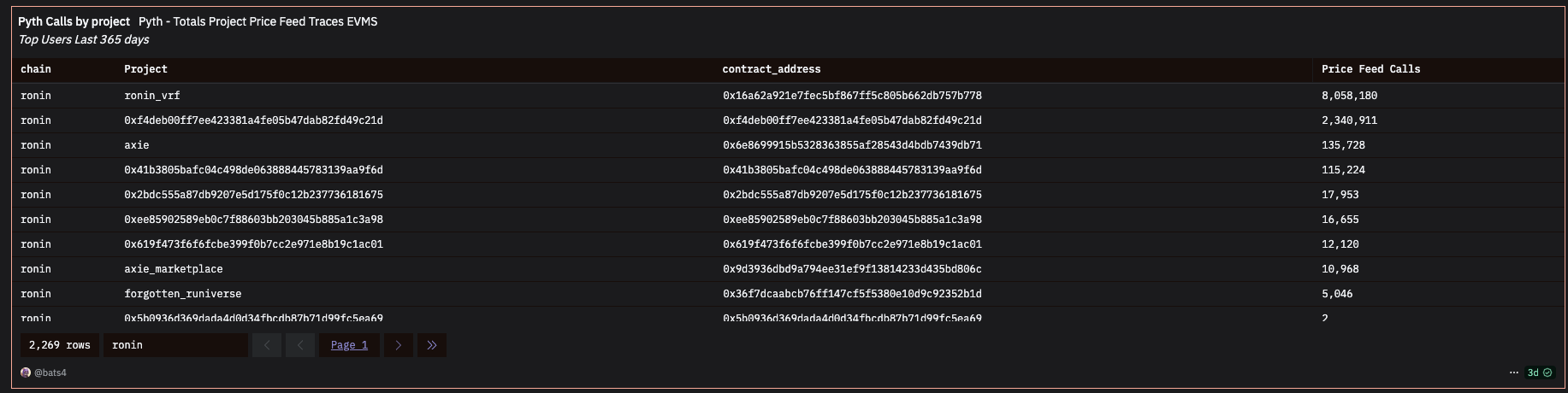
> [@scp](#):
>
> Additionally, I’m curious why the fees are denominated in their native token ($RON) instead of USD.
Price Feed update fees on every chain are configured to be
1 of the smallest denomination of the blockchain’s native token (e.g., 1 wei on Ethereum),
(Reference: [Pyth Docs](https://docs.pyth.network/price-feeds/how-pyth-works/fees))
I do not have information on why it was built/coded like that in the first place but i see it as an effective way for regular users and protocols to easily use Pyth price feeds with less “friction” since wallets will always have native tokens for gas. To Pyth team, Please correct me if there is a different reason.
> [@scp](#):
>
> Nobody can say for sure whether the current “optimal” fee reflects real value or just temporary market conditions. A different “optimal” fee could emerge two months from now. This could see as a added uncertainty and instability from other projects —something they would have to absorb in an already chaotic market.
i still think it is something that can be “optimized”,
kinda like how gas fees, ie: Sol gas fees are i think flat fees even when Sol was at $2 or $200. Isn’t being flexible and have fees change via DAO discussions/governance a plus in this case?
> [@scp](#):
>
> Apologies if this comes off as a bit pessimistic.
>
> I am just raising my personal concerns from a different perspective for potential fallback. This doesn’t mean that I would against fee implementation. If revenue obtained is really good and usage didn’t negatively impacted, it is a good idea, like opBNB I guess.
Having different perspective is a plus for discussions like this. I, personally, encourage you and others who have thoughts about the matter to voice them out on the forums. As @KemarTiti said in the first post, Community Feedback are always welcome!
---
### Author:  [@KemarTiti](https://forum.pyth.network/u/KemarTiti)
#### Post date: [May 5, 2025, 8:42am UTC](https://forum.pyth.network/t/implement-fees-on-pyth-core-across-networks-2/2114/17 "2025-05-05T08:42:49Z")
> [@scp](#):
>
> A subscription model might not be perfect, but it offers predictable pricing — which could be more attractive for many protocols. Long-term partnerships could even benefit from volume-based discounts or premium tiers. We can also have different subscription tiers, for example: a basic tier for pyth core, a mid-tier for 200ms pyth laser, a top-tier for 1ms pyth laser.
This is a thoughtful suggestion. That said, the current design of Pyth Core doesn’t support such a model easily — implementing it would likely require significant changes to the protocol architecture. Still, it’s a promising direction for the future.
In the meantime, I believe it’s important to start raising fees incrementally. This not only reflects the value of the service but also helps establish a reference point for any future subscription-based pricing models.
> [@scp](#):
>
> Additionally, I’m curious why the fees are denominated in their native token ($RON) instead of USD
This is currently how fees are structured across all supported chains. I agree that USD-denominated pricing would offer a clearer cost reference, and it’s something that could become more feasible with a future shift to a subscription model.
> [@scp](#):
>
> Nobody can say for sure whether the current “optimal” fee reflects real value or just temporary market conditions. A different “optimal” fee could emerge two months from now.
Completely agree — “perfect” pricing is a moving target, and trying to optimize for every user on every chain isn’t realistic, especially under the current design of Pyth Core.
That said, introducing a reasonable baseline — somewhere in the range of $0.005 to $0.02 — provides a useful starting point. It helps us gather real-world data, which will be critical for refining future pricing strategies.
> [@TRiLeZ](#):
>
> I want to suggest grandfathering existing customers into any new pricing models. Existing customers will appreciate a greater horizon of fee stability to plan and budget accordingly.
This suggestion makes sense in principle, but the challenge lies in execution. Implementing grandfathering would introduce considerable operational complexity, especially since only the DAO can approve and enforce such onchain exceptions.
> [@TRiLeZ](#):
>
> Together with the grandfathering mechanism, this could allow pre-customers with plans of integration enough time to lock in the current rates, considering that they’ve done planning and budgeting with the current pricing structure in mind.
I don’t think locking in current rates is a viable option — the existing Pyth fees are effectively zero, and maintaining that would mean foregoing any meaningful revenue.
While I understand the need for cost predictability, a one-time increase in fees is generally manageable. For instance, if fees go up 5x, a user could simply reduce the frequency of updates (e.g., from every 1s to every 5s) to stay within budget.
---
### Author:  [@paddymcpearls](https://forum.pyth.network/u/paddymcpearls)
#### Post date: [May 5, 2025, 10:08am UTC](https://forum.pyth.network/t/implement-fees-on-pyth-core-across-networks-2/2114/18 "2025-05-05T10:08:18Z")
As a builder on the Flow blockchain, I am all for increasing fees for the usage of Pyth oracles since right now, admittedly, the cost is incredibly low. However a 250x increase in one shot seems like quite a lot to me. The ecosystem is still in its infancy and has not yet had the chance to reach a sustainable state of usage. For example, the protocol I contribute to only has 150 active wallets, so while TVL is up, it’s still quite concentrated. It would make more sense to me for the increase in price to be tiered with an initial increase to $0.005 per feed update, resulting in ~$125 of monthly fees and when the ecosystem has matured further, increase to $0.01 per feed. As it stands, if the monthly cost were $125, at least for the nascent protocol I work on, this would represent about 15-20% of monthly protocol revenue.
---
### Author:  [@KemarTiti](https://forum.pyth.network/u/KemarTiti)
#### Post date: [May 7, 2025, 12:36pm UTC](https://forum.pyth.network/t/implement-fees-on-pyth-core-across-networks-2/2114/19 "2025-05-07T12:36:05Z")
Thanks a lot for the perspective and data @paddymcpearls !
And to be fair, I am rather fine with your the suggested mid-way point offered ; meaning: 0.015 FLOW / price update
You could also reduce frequency of updates by 2 in case - would that work for your protocol at all?
---
### Author:  [@paddymcpearls](https://forum.pyth.network/u/paddymcpearls)
#### Post date: [May 8, 2025, 12:14pm UTC](https://forum.pyth.network/t/implement-fees-on-pyth-core-across-networks-2/2114/20 "2025-05-08T12:14:08Z")
That sounds good. I really appreciate the DAO being flexible with us. Let’s do it! And we’ll adjust frequency accordingly.
---
### Author:  [@Kaleb](https://forum.pyth.network/u/Kaleb)
#### Post date: [May 30, 2025, 7:19am UTC](https://forum.pyth.network/t/implement-fees-on-pyth-core-across-networks-2/2114/21 "2025-05-30T07:19:32Z")
Hello Pyth Community,
We understand and support the rationale behind implementing and standardizing fees for accessing Pyth’s oracle services. The sustainability of the network and the ability to continue incentivizing high-quality data providers are crucial for the ecosystem’s health, and we commend the Pyth DAO’s efforts in this direction.
Synthetix currently utilizes Pyth oracles on Optimism and Base. However, we are in the process of a significant strategic shift. We are planning to deprecate our current offerings on these Layer 2 networks and will be consolidating our efforts by launching a new, distinct offering on Ethereum mainnet. This transition is a substantial undertaking for our protocol.
Given this context, the upcoming fee increases on Optimism and Base would impact our services during a transitional period where we are actively working to migrate away from them. While we are fully supportive of the fee model for ongoing and new deployments, we would greatly appreciate it if the Pyth team could consider a temporary grace period of the new fee structure for our existing services on Optimism and Base that are nearing end of their lifecycle.
This consideration would significantly help us manage resources effectively during this transitionary phase before we move to our new Ethereum-based offering, where we intend to continue leveraging Pyth’s oracle services.
We are happy to provide further details about our transition timeline and discuss this matter more comprehensively, as we get clearer on our transition to mainnet.
Thank you for your understanding and for providing essential infrastructure to the DeFi community.
[Next page](https://forum.pyth.network/t/implement-fees-on-pyth-core-across-networks-2/2114.md?page=2)